SAVE 15% OFF ON YOUR FIRST ORDER - USE CODE PERFORM15 AT CHECKOUT

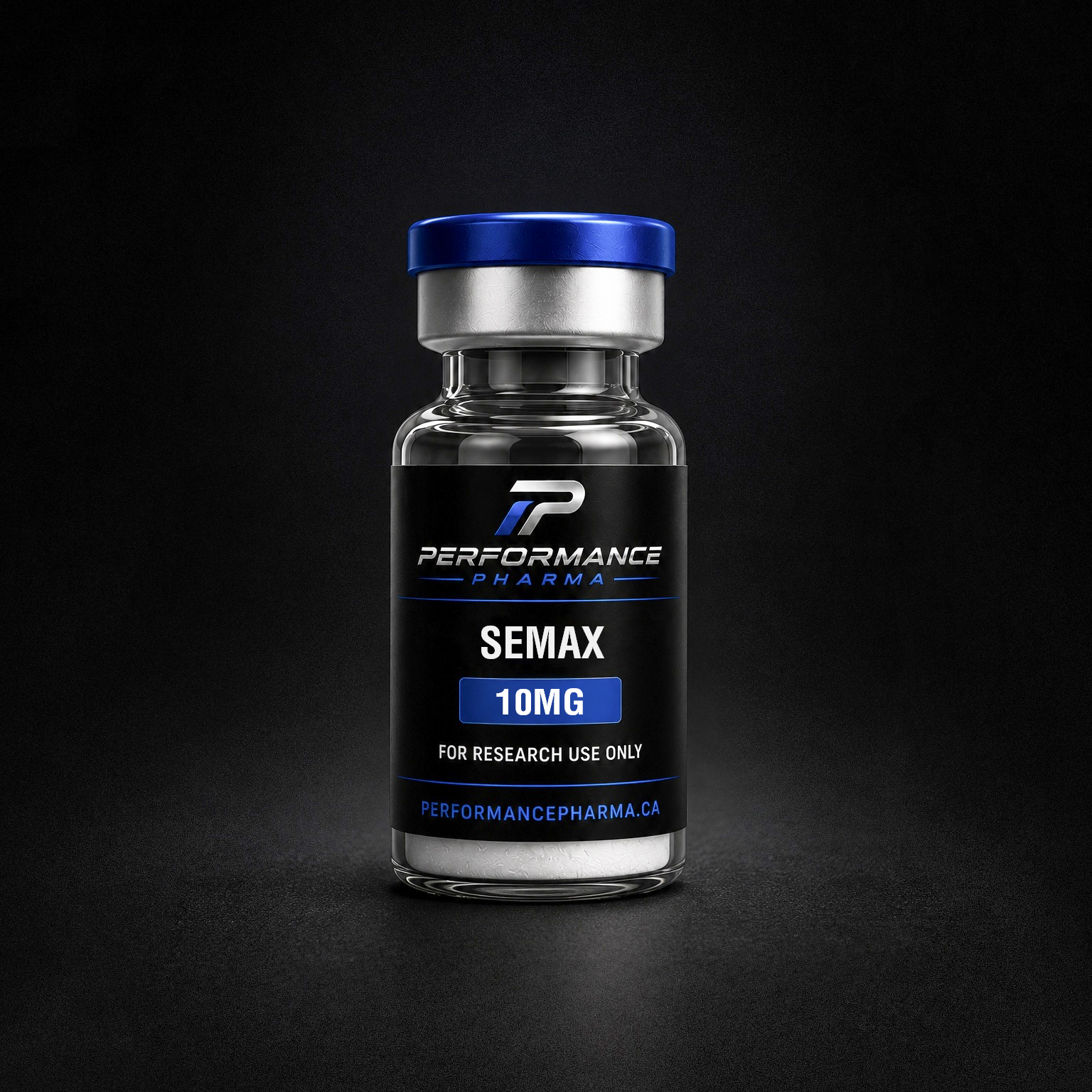

Semax – Research Peptide Canada
$55.00
Semax is a synthetic peptide derived from adrenocorticotropic hormone (ACTH) fragments. It has been extensively studied for its potential influence on cognition, neuroprotection, learning, and memory-related pathways.
Description
Semax is a synthetic heptapeptide derived from the adrenocorticotropic hormone (ACTH) fragment ACTH(4–10), modified to enhance metabolic stability while eliminating the hormonal activity associated with the parent peptide. Originally developed through neuropharmacology research, Semax has become an important investigational compound for studying neuroprotection, cognitive function, neuroplasticity, and cerebral physiology.
Unlike full-length ACTH, Semax does not significantly stimulate adrenal corticosteroid production. Instead, experimental research suggests it influences multiple signaling pathways within the central nervous system, including those involved in brain-derived neurotrophic factor (BDNF) expression, neuronal survival, neurotransmitter regulation, and synaptic plasticity.
Although Semax has been investigated in numerous laboratory studies and several clinical settings, many aspects of its mechanism of action continue to be explored, and additional high-quality international research is needed to further characterize its biological effects.
Research Overview
Semax was developed to investigate whether a modified fragment of ACTH could retain neurobiological activity while avoiding the endocrine effects of the parent hormone. Through structural modification, researchers produced a peptide with increased resistance to enzymatic degradation and enhanced stability for experimental investigation.
Over the past several decades, Semax has been studied across multiple areas of neuroscience, including cognitive performance, cerebral ischemia, neurodegeneration, learning and memory, and recovery following neurological injury.
Current evidence suggests Semax influences several interconnected pathways involved in neuronal adaptation rather than acting through a single molecular target. This broad mechanism has made it an important research tool in experimental neuroscience.
Mechanism of Action
Semax appears to influence multiple neurobiological pathways that regulate neuronal function and adaptation.
Neurotrophic Factor Regulation
One of the most extensively investigated mechanisms involves modulation of brain-derived neurotrophic factor (BDNF) and other neurotrophins.
Experimental studies suggest Semax may influence:
- Neuronal survival
- Synaptic plasticity
- Learning-associated signaling
- Cellular adaptation following neurological stress
Researchers continue to investigate the significance of these observations across different neurological models.
Neurotransmitter Modulation
Laboratory investigations indicate Semax may affect several neurotransmitter systems, including:
- Dopaminergic signaling
- Serotonergic pathways
- Glutamatergic transmission
These interactions remain an active area of neuropharmacological research.
Neuroprotection
Experimental models have demonstrated potential effects on oxidative stress, inflammatory signaling, and neuronal resilience following ischemic or traumatic injury.
Further investigation is required to determine the relative contribution of these mechanisms to overall neurological function.
Gene Expression
Modern molecular studies suggest Semax influences the expression of numerous genes involved in inflammation, neuronal repair, synaptic organization, and neuroplasticity.
These genomic effects continue to be investigated using advanced transcriptomic techniques.
Current Scientific Research
Semax has been investigated in laboratory studies, animal models, and a number of clinical investigations, particularly within neurological research.
Cognitive Neuroscience
Researchers continue to examine Semax in relation to:
- Learning
- Memory formation
- Attention
- Executive function
- Cognitive adaptation
Experimental studies suggest these effects may be associated with neurotrophic signaling and synaptic plasticity.
Cerebral Ischemia Research
Semax has been extensively studied in experimental models of cerebral ischemia and stroke, where investigators have examined its influence on neuronal survival, inflammatory responses, and functional recovery.
These findings continue to support further investigation into mechanisms of neuroprotection.
Neurodegenerative Research
Laboratory research is exploring Semax within models of age-related neurodegeneration and neuroinflammation to better understand pathways involved in neuronal maintenance and disease progression.
Molecular Neuroscience
Current investigations continue to evaluate Semax’s influence on gene expression, neuronal communication, and adaptive responses within the central nervous system.
Potential Research Applications
Current scientific literature is investigating Semax in relation to:
- Neuroprotection
- Cognitive neuroscience
- Learning and memory
- Synaptic plasticity
- Cerebral ischemia
- Neuroinflammation
- Neurodegenerative disease models
- Neurotrophic factor biology
- Molecular neuroscience
These represent active areas of scientific investigation and should not be interpreted as established therapeutic indications.
Product Snapshot
Research Category: Neuroprotective Research Peptide
Derived From: ACTH(4–10)
Primary Biological Areas of Investigation:
- Brain-derived neurotrophic factor (BDNF)
- Neuroplasticity
- Cognitive function
- Neuronal survival
- Neurotransmitter regulation
Research Administration Route: Experimental laboratory use
Development Status: Extensive preclinical research with multiple clinical investigations
Evidence Strength: ★★★★☆
Strong laboratory evidence supported by animal studies and a growing body of human clinical research, particularly in neurological investigation.
Key Scientific References
Ashmarin IP, Nezavibat’ko VN, Levitskaya NG, et al. Design and Biological Activity of the ACTH(4–10) Analog Semax. Neuroscience and Behavioral Physiology.
A foundational publication describing the development of Semax, its structural modifications, and its early neurobiological activity.
Kolomin TA, et al. Effects of Semax on Gene Expression Following Experimental Cerebral Ischemia. BMC Genomics.
An important molecular study demonstrating that Semax influences the expression of numerous genes involved in inflammation, neuronal repair, and neuroplasticity after experimental ischemic injury.
Dolotov OV, et al. Molecular Mechanisms of the Neuroprotective Activity of Semax. Frontiers in Neuroscience.
A comprehensive review summarizing current understanding of Semax, including its effects on BDNF signaling, neurotransmitter regulation, and neuroprotective pathways.
Zolotarev YA, et al. Semax and Neurotrophic Regulation in Experimental Neuroscience. Neuroscience and Behavioral Physiology.
A review examining the relationship between Semax, neurotrophic factors, neuronal adaptation, and cognitive function across experimental models.
PubMed – Semax Research
A continually updated collection of peer-reviewed publications examining Semax across neuroprotection, cognitive neuroscience, cerebral ischemia, neuroplasticity, and molecular neurobiology.
Research Use Statement
For Research Use Only.
Semax supplied by Performance Pharma is intended exclusively for laboratory and scientific research conducted by qualified professionals. This product is not approved for human or veterinary use and is not intended to diagnose, treat, cure, or prevent any disease. It should be handled, stored, and used in accordance with applicable laws, regulations, and accepted laboratory research practices.
Additional information
| Size | 10MG |
|---|
Reviews (0)
Shipping and Delivery


Related products
Sold out
Select options
This product has multiple variants. The options may be chosen on the product page
DSIP – Research Peptide
$55.00
Select options
This product has multiple variants. The options may be chosen on the product page
Reviews
There are no reviews yet.